The baseline numbers
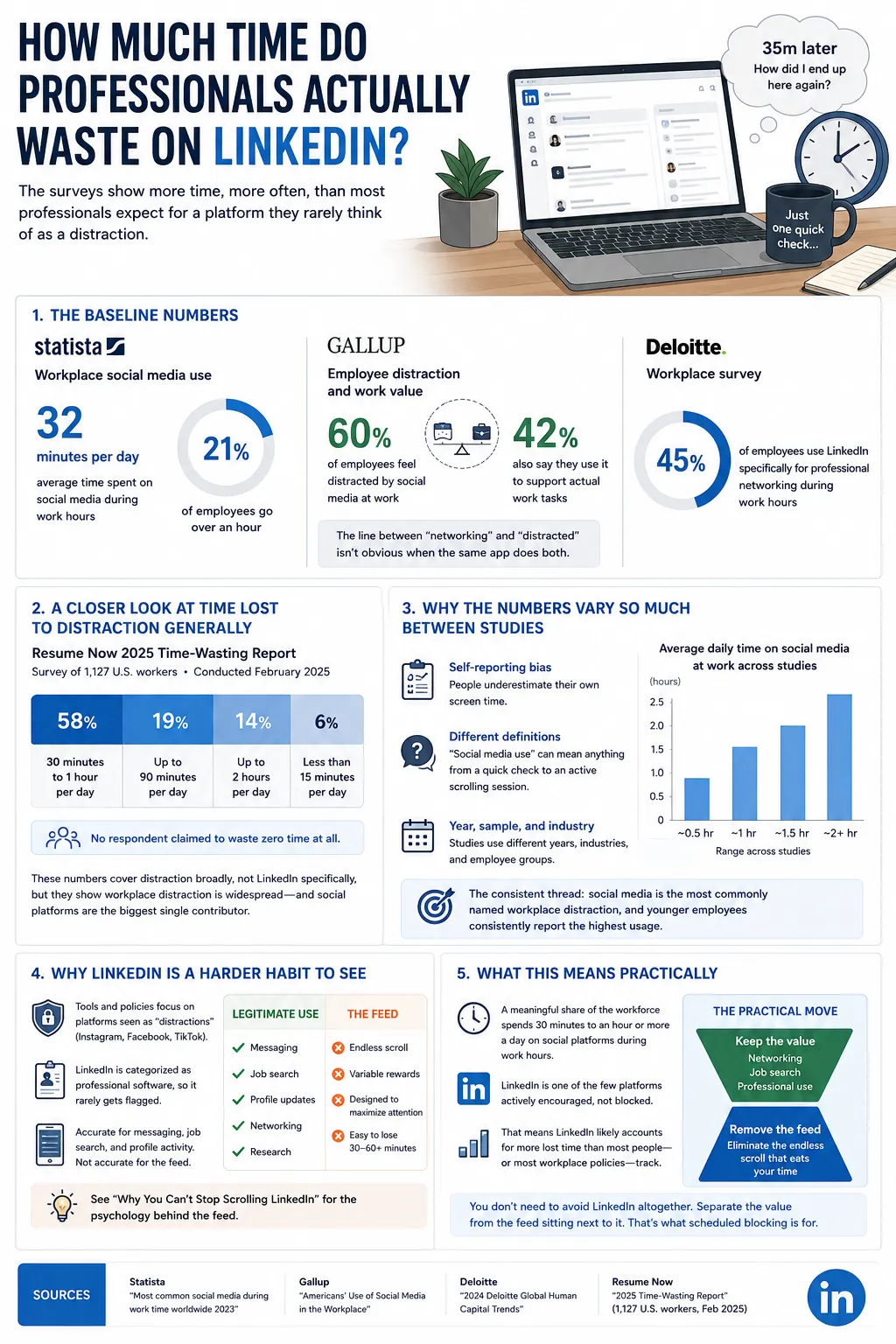
Statista's research on workplace social media use puts the average employee at about 32 minutes a day on social media during work hours, with 21% of employees going over an hour. Gallup's research found that 60% of employees feel distracted by social media at work, though a notable share, 42%, also say they use it to support actual work tasks like networking or research. That second number matters, because it points at the exact problem LinkedIn creates: the line between "networking" and "distracted" isn't obvious when the same app handles both.
Deloitte's workplace survey found that 45% of employees use LinkedIn specifically for professional networking during work hours. That's a large share of the workforce opening a platform for a legitimate reason and landing directly next to a feed engineered to hold their attention well past that original reason.
A closer look at time lost to distraction generally
The 2025 Time-Wasting Report from Resume Now, based on a survey of 1,127 U.S. workers conducted in February 2025, found that 58% of employees waste between 30 minutes and an hour per day on non-work distractions like social media, personal email, and online shopping. Nearly one in five, 19%, reported wasting up to 90 minutes daily, and 14% reported up to two hours. Only 6% said they waste less than 15 minutes a day, and the report noted that no respondent claimed to waste zero time at all.
These numbers cover distraction broadly, not LinkedIn specifically, but they set useful context: workplace distraction isn't a fringe behavior reported by a small group of undisciplined employees. It's close to universal, and social platforms are consistently named as the biggest single contributor.
Why the numbers vary so much between studies
If you look across workplace social media surveys, the reported averages swing widely, from roughly half an hour a day up to two or more hours depending on the study, the year, and how the question was asked. Some of that gap comes down to self-reporting: people tend to underestimate their own screen time, and how a survey defines "social media use" (checking a notification versus an active scrolling session) changes the answer significantly. The consistent thread across nearly every study, regardless of the exact number, is that social media is the most commonly named workplace distraction, and younger employees consistently report the highest usage.
Why LinkedIn is a harder habit to see
Time-tracking software and workplace policies are generally built around the platforms people already associate with wasted time: Instagram, Facebook, TikTok. LinkedIn rarely gets flagged the same way, both by employees and by the tools meant to monitor distraction, because it's categorized as professional software. That categorization is accurate for messaging, job search, and profile activity. It does not hold for the feed, which runs on the same engagement mechanics as any other social platform. See why you can't stop scrolling LinkedIn for more on how that works.
What this means practically
If a meaningful share of the workforce is spending 30 minutes to an hour or more a day on social platforms during work hours, and LinkedIn is one of the few platforms actively encouraged rather than blocked, LinkedIn likely accounts for more of that lost time than most people, or most workplace policies, currently track. You do not need to avoid LinkedIn altogether. The networking and job-search value is real. The practical move is to separate that value from the feed sitting next to it, which is what scheduled blocking is for.
Sources referenced: Statista workplace social media research; Gallup employee distraction survey; Deloitte workplace social media survey; Resume Now 2025 Time-Wasting Report (1,127 U.S. workers, surveyed February 2025).