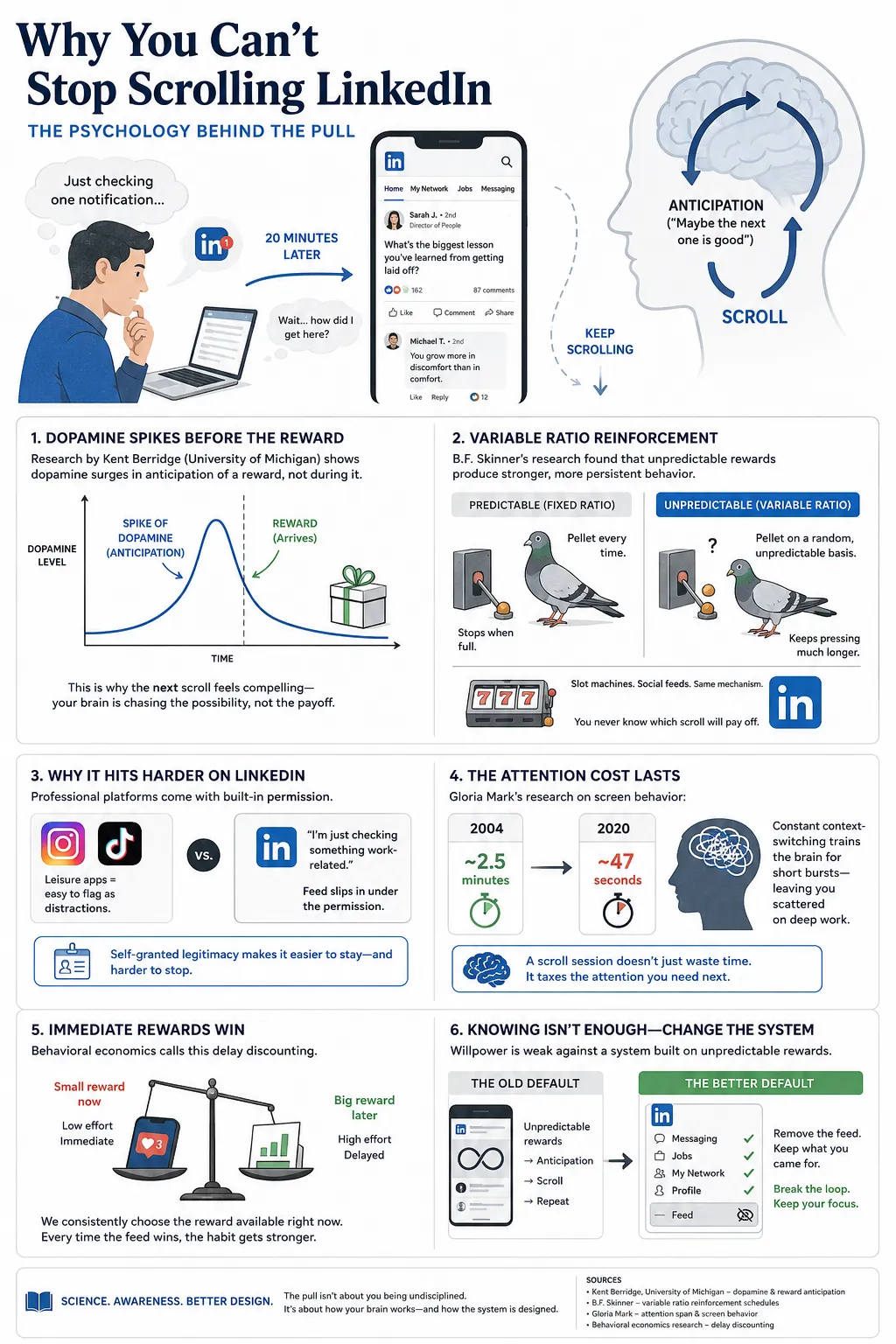
Dopamine spikes before the reward, not during it
Most people describe dopamine as a "pleasure chemical." Neuroscientist Kent Berridge's research at the University of Michigan drew a distinction between wanting and liking, and found that dopamine surges happen in anticipation of a reward, before it arrives, not while you're experiencing it. The spike is what makes you reach for the next scroll. It is not what you feel once you get there.
That explains why the feed feels compelling even when the content itself is mediocre. You're not chasing satisfaction from the post you just read. You're chasing the possibility of what the next one might be.
The mechanism is called variable ratio reinforcement
B.F. Skinner's research on reinforcement schedules found that unpredictable rewards produce stronger, more persistent behavior than predictable ones. A pigeon that gets a food pellet every time it presses a lever eventually stops pressing once it's full. A pigeon that gets a pellet on a random, unpredictable schedule keeps pressing far longer, because it never knows which press will pay off.
Slot machines run on that same schedule. So does LinkedIn's feed. Every scroll might surface something useful, something forgettable, or something that stirs a reaction. Since you can't predict which one is coming, your brain stays in a low-level state of anticipation that keeps you scrolling to find out.
Why this hits harder on a "professional" platform
Instagram and TikTok get flagged in most people's minds as leisure apps, which makes it easier to notice when you're overusing them. LinkedIn doesn't get that same mental flag. You open it to check a message or a job posting, tell yourself it's work-related, and the feed slips in underneath that permission. Researchers studying attention and platform design point to this kind of self-granted legitimacy as one reason professional platforms can be harder to put down than ones people already think of as distracting.
The attention cost doesn't end when you close the tab
Attention researcher Gloria Mark, who has spent years studying screen behavior, found that the average attention span people sustain on a screen dropped from around two and a half minutes in 2004 to about 47 seconds by 2020. Constant context-switching between short bursts of content trains the brain to expect that rhythm everywhere, including in tasks that require sustained focus. A scroll session on LinkedIn can leave you feeling scattered on the work you sit down to do right after.
Immediate rewards beat long-term ones almost every time
Behavioral researchers call this delay discounting: given a choice between a smaller reward now and a bigger one later, people consistently favor the one available immediately. A new comment or a mildly interesting post is available right now. Finishing a report, prepping for a meeting, or making progress on a hard problem pays off later. Every time the feed wins that comparison, the brain logs it as the more rewarding option, which makes it slightly more likely to win again next time.
Knowing the mechanism doesn't cancel it out
Understanding the neuroscience does not automatically make the pull weaker in the moment. It does change the strategy, though. Willpower alone is a weak tool against a system built on unpredictable rewards, because that system is designed to outlast a single burst of restraint. A more durable fix is removing the mechanism from view: messages, jobs, and your profile stay fully usable, and the part of the platform built to keep you scrolling is not there to trigger the loop. That is the premise behind LinkedIn Feed Blocker.
Sources referenced: research on dopamine and reward anticipation (Kent Berridge, University of Michigan); B.F. Skinner's work on variable ratio reinforcement schedules; Gloria Mark's research on attention span and screen behavior; behavioral economics research on delay discounting.